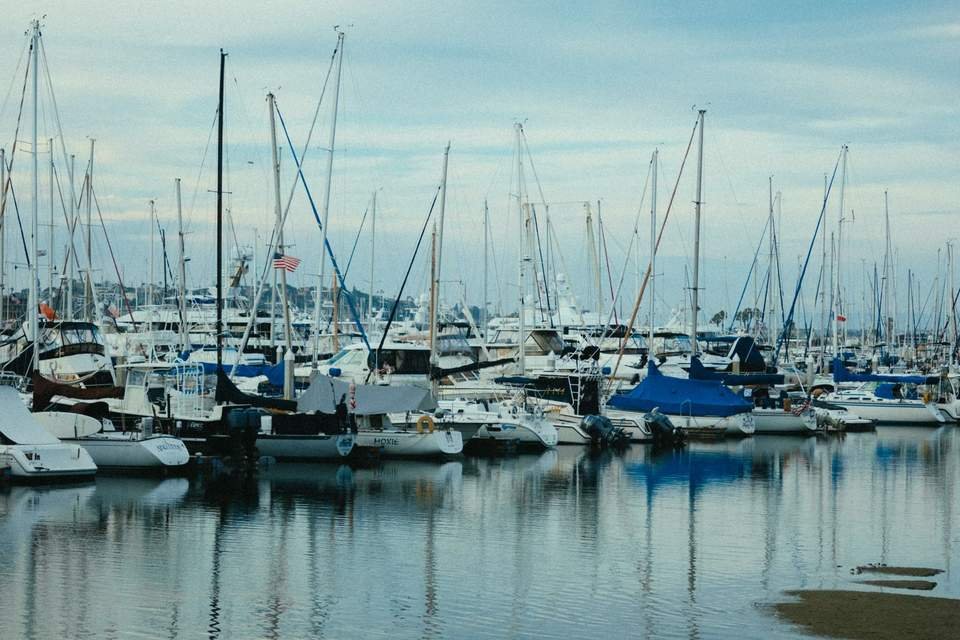
Discover Boating, the consumer program of the National Marine Manufacturers Association (NMMA), defines a mooring as permanent ground tackle fixed to a buoy that boats can tie to. That is different from dropping your own anchor for a swim stop, and different from tying up in a marina slip. This guide fills that mooring gap: how to recognize a mooring buoy, how permanent moorings are built (at a high level from official sources), how public and private moorings differ, how to pick one up without inventing rode lengths, and basic field etiquette drawn from NOAA and National Park Service pages. For setting your own anchor, see anchoring basics. For slips and docks, see docking basics.
We do not invent scope ratios, rode lengths, mooring fees or local permit rules. Confirm where you boat with State Rules and the marina, harbor master or sanctuary that owns the field.
Mooring vs anchoring vs docking
| What holds the boat | Typical gear | When you use it | |
|---|---|---|---|
| Mooring | Permanent ground tackle already on the bottom, marked by a buoy you tie to (Discover Boating glossary) | Your bow lines through the buoy's pickup; the heavy tackle stays on the bottom | Overnight in a mooring field, reef day-stops on sanctuary buoys, or a rented/private ball |
| Anchoring | Your own temporary ground tackle | Anchor, chain and rode you carry and set | Coves, overnight when no ball is available—see anchoring basics |
| Docking | A dock, pier or slip | Dock lines, fenders, spring lines | Fuel docks, slips, transient berths—see docking basics |
Discover Boating's first-sail overview notes a practical difference many new sailors feel right away: boats on moorings point into the wind, which is ideal for raising sails. When the mooring line is cast off, the boat drifts backward until you fill the sails and steer clear of nearby moored boats.
How to recognize a mooring buoy
Federal aids-to-navigation rules recommend a distinctive color so mooring buoys are not confused with channel markers. 33 CFR 62.35 says mooring buoys are white with a blue horizontal band. Discover Boating's navigation-buoy guide describes the same look (white with a blue stripe) and adds the key etiquette note: most are private and you need permission to use them.
Public systems use the same white-and-blue pattern in many places. NOAA's Florida Keys National Marine Sanctuary describes white spherical buoys with a blue stripe as reef moorings. Maryland DNR requires recreational mooring buoys to be white with a horizontal blue band centered between the top of the buoy and the waterline (and allows ownership ID such as a registration or documentation number or vessel name).
Red/green channel markers and yellow sanctuary boundary buoys are not moorings—do not tie to them (NOAA FKNMS: yellow boundary buoys have no mooring lines and vessels may not tie up to them).
What a permanent mooring is made of
Official sources describe the bottom end of a mooring as heavy, permanent tackle—not the lightweight anchor you keep in a locker:
- Discover Boating's types-of-anchors page: very large mushroom anchors are used for moorings or securing buoys (small mushrooms are only for soft river bottoms on PWCs, small aluminum boats or dinghies).
- Maryland DNR: mooring buoys are secured either by being drilled into the waterway bed or by a heavy mushroom or similar anchor with enough weight to hold the boat.
- NOAA Florida Keys: sanctuary moorings use a seabed anchor, down line, buoy through-line, surface buoy, and a floating pick-up line—maintained on a published inspection schedule. The sanctuary's how-to diagram labels those parts and the correct boat attachment.
That permanent tackle is why a mooring field can pack boats more tightly than a free-swinging anchorage at long scope: each boat hangs off fixed gear sized for the field, not off whatever rode each skipper chose that afternoon. We do not publish scope or rode lengths for picking up a ball—those belong to temporary anchoring (anchoring basics cites Discover Boating's 7:1 guidance for your rode). For mooring-line length at a slip, Discover Boating says length is simply a matter of slip and boat size, with lines rated on the packaging.
Public sanctuary moorings vs private balls
Florida Keys National Marine Sanctuary (NOAA) maintains hundreds of reef mooring buoys so boaters can stop without anchoring on living coral (anchoring on living coral is prohibited in the sanctuary). Key facts from the sanctuary's buoy pages:
- Standard 18-inch buoys support vessels up to 59 feet; larger 24-inch buoys support 60–100 feet at listed wreck and SPA sites.
- Sanctuary reef moorings are first-come, first-served and no fee to the boater; the sanctuary notes that other mooring buoys in Keys anchorages may charge a fee.
- If no buoy is available and you are outside a no-anchor zone, you may anchor in sandy areas away from coral and seagrass.
- The sanctuary assumes no liability for use of the buoys.
Private and commercial balls. Discover Boating: most white-and-blue mooring buoys are private—get permission (or a paid reservation) before you grab one. State and local rules vary for installing your own buoy; Maryland DNR, for example, distinguishes single recreational, group (3+ under one entity) and commercial moorings, references U.S. Army Corps of Engineers Section 10 permits, and lists placement limits (swing arc, channels, shellfish beds, cable crossings, and local town rules). Treat Maryland as an example of how detailed local placement rules can be—check your state agency and State Rules, not this page, for what applies where you boat.
Picking up a mooring (official how-to)
Use the buoy's pickup gear and your own bow lines. NOAA Florida Keys' official how-to diagram is explicit:
- Never tie the pick-up line directly to the boat.
- Loop your bow line through the pick-up line (through the eye/loop of the floating pickup), then take your bow line back to your own bow cleat.
That keeps the sanctuary's pickup hardware from taking the full load of your boat and matches the "bow, not stern" seamanship theme in our anchoring and docking guides. Virgin Islands National Park (NPS) likewise prohibits securing vessels to the mooring using stern cleats.
Practical approach habits from Discover Boating's docking and cleat-hitch pages (same wind/current ideas apply when you nose up to a ball):
- Prep early: have bow lines ready and know how to finish with a cleat hitch (Discover Boating covers the cleat hitch for docks and mooring balls).
- Come in slow, reading wind and current the way you would for a dock—Discover Boating's golden rule is never approach faster than you're willing to hit.
- If you miss, abort and circle—backing out and taking another run is normal (docking guide). Hands and feet stay in the boat during the approach.
We do not invent a multi-line bridle recipe, pennant lengths or "boat lengths of approach" beyond what those official pages show. Local harbor masters and charter outfits often publish field-specific pickup steps—follow those when they conflict with a general overview.
Mooring-field etiquette (from official park and sanctuary rules)
Rules differ by field. The following are published examples—not a universal code:
NPS Virgin Islands National Park (quick mooring information):
- White moorings with blue stripes: vessels ≤ 60' LOA; larger white/red "big boat" moorings: 61'–100' LOA (other colors mark dive, fishing, commercial or dinghy use—read the park page before you grab one).
- Prohibited: using an anchor while on a mooring; securing to the mooring with stern cleats; modifying moorings without a written NPS permit; operating over 5 mph or creating a wake in mooring fields or within 500 ft of a mooring field.
- Vacate moorings when tropical storm warnings are forecast for the area.
- Overnight use can require self-registration fees and stay limits (the park publishes those numbers—confirm on the NPS page; we do not reprint fee schedules here as if they were nationwide).
NOAA Florida Keys: use a buoy rated for your length; prefer sanctuary moorings over anchoring on coral; do not tie to yellow boundary buoys.
Everywhere: Discover Boating—ask before using a private ball. Leave swing room, keep wake down near moored boats, and treat pickup pennants and through-lines as shared infrastructure (NOAA maintains them on a schedule because misuse wears them out).
For required carriage gear while underway (PFDs, fire extinguishers, visual distress signals, sound devices, navigation lights), see required safety equipment by length. Lights and shapes when you are at anchor are summarized in anchoring basics from Inland Rule 30 (33 CFR 83.30); Coast Guard special anchorage areas in 33 CFR Part 110 can exempt vessels under 20 meters from those anchor lights/shapes when at anchor in a designated area. Confirm whether your overnight spot is in such an area and what the harbor requires for boats on permanent moorings.
After the ramp and before you leave the boat
Ramp and trailer sequence stay on the printable Launch Day checklist and trailer safety and maintenance—mooring does not replace those checks. If you keep the boat on a mooring instead of a trailer between trips, budget mooring or slip fees in the True Cost tool, and still keep ground tackle aboard as safety gear (Discover Boating treats docking, anchoring and mooring gear as safety equipment when you need to stay put).
Sailors learning on a club or school boat often start and end on a mooring; see first-time sailing for the cast-off sequence Discover Boating describes.
Sources
- Mooring defined as permanent ground tackle fixed to a buoy: Discover Boating (NMMA), Boating Glossary (M). https://www.discoverboating.com/glossary-items/m
- White buoy with blue stripe = mooring; most private / need permission: Discover Boating (NMMA), "Navigation Buoys 101." https://www.discoverboating.com/resources/navigation-buoys-and-channel-markers
- Mooring buoys white with blue horizontal band (recommended scheme): 33 CFR 62.35 (via Cornell LII; eCFR CAPTCHA-blocked to research UA). https://www.law.cornell.edu/cfr/text/33/62.35
- Cleat hitch also for mooring balls; materials (cleat + line): Discover Boating (NMMA), "How to Tie a Cleat Hitch Knot." https://www.discoverboating.com/resources/cleat-hitch-knot
- Mooring gear as safety gear; line types; mooring-line length = slip and boat size (no invented lengths): Discover Boating (NMMA), Docking Equipment & Anchoring Accessories. https://www.discoverboating.com/boating-accessories/docking-equipment-anchoring
- Large mushroom anchors for moorings/buoys: Discover Boating (NMMA), "Types of Anchors." https://www.discoverboating.com/resources/types-of-boat-anchors
- Boats on moorings point into wind; cast-off drifts backward; clear nearby moorings: Discover Boating (NMMA), "Your First Sail." https://www.discoverboating.com/resources/your-first-sail
- Approach slow; wind/current; abort and retry; hands/feet in; golden rule: Discover Boating (NMMA), "Boat Dock Safety: Tips and Step-by-Step Guide." https://www.discoverboating.com/resources/docking-a-boat-step-by-step-guide
- White/blue reef moorings; 18"/≤59' and 24"/60–100'; first-come free sanctuary buoys vs fee anchorages; no anchor on living coral; sandy anchor alternative; no tie to yellow boundary buoys: NOAA Florida Keys National Marine Sanctuary, Buoy Program. https://floridakeys.noaa.gov/mbuoy/
- Never tie pick-up line directly to boat; loop bow line through pick-up line; system parts (anchor, down line, through-line, buoy, pick-up); no sanctuary liability: NOAA FKNMS, "How to Use a Mooring Buoy" (incl. official diagram). https://floridakeys.noaa.gov/mbuoy/howto.html
- Size/color codes; no anchor while on mooring; no stern-cleat attachment; no wake / 5 mph in fields; storm vacate; overnight self-registration note: NPS Virgin Islands National Park, Quick Mooring Information. https://www.nps.gov/viis/planyourvisit/quick-mooring-information.htm
- Permanent tackle (drill or heavy mushroom); white + blue band; placement/swing/channel/shellfish examples; Corps Section 10 context: Maryland DNR, Mooring Buoys. https://dnr.maryland.gov/boating/pages/srmbuoys.aspx
- Anchor lights/shapes and special-anchorage exemption context: Inland Navigation Rules Rule 30 (33 CFR 83.30) via Cornell LII; 33 CFR 110.1 via Cornell LII (eCFR CAPTCHA-blocked). https://www.law.cornell.edu/cfr/text/33/83.30 · https://www.law.cornell.edu/cfr/text/33/110.1